Carpentry Hand Tools
For Our Green Oak Framing
Here is an overview of some of the tools we use in our oak framing workshop at Sessile Oak.



Here is an overview of some of the tools we use in our oak framing workshop at Sessile Oak.
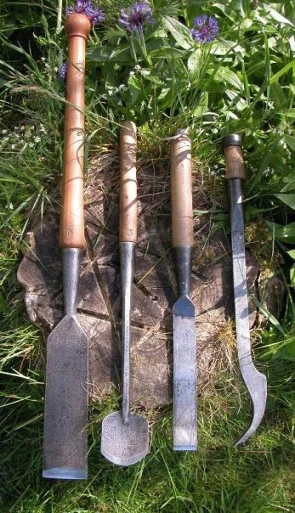
There are many chisels and gouges to be found amongst the timber framer's favoured tools, varying in size and type according to their purpose. They range from the fairly commonplace, such as firmer, bevel-edged and mortice chisels, to the very specialised, such as slicks, swan-necked chisels and paring gouges. All must be kept scrupulously clean and sharp.
These days, much of the rough chopping out of mortices is done using a morticing machine although the finishing is still done with a chisel.
 Hand planes are essential in the shaping of joint shoulders and faces,
in addition to smoothing other surfaces. There is no better way of
"splitting the line" on a marked timber than with a well sharpened and
set plane.
Hand planes are essential in the shaping of joint shoulders and faces,
in addition to smoothing other surfaces. There is no better way of
"splitting the line" on a marked timber than with a well sharpened and
set plane.
Drawknives and spokeshaves are ideal for removing excess sapwood and for shaping the edges of curved timbers such as braces.
 The most common saw in the timber framer's tool kit is the hand saw.
Increasingly, due to the amount of time involved in sharpening and setting,
traditional rip and cross-cut saw are being replaced with modern multi-purpose
"hardpoint" saws.
However, bowsaws are still useful for cutting fine curves.
For the most part, large saws such as pit saws have been superseded by modern
milling machines.
The most common saw in the timber framer's tool kit is the hand saw.
Increasingly, due to the amount of time involved in sharpening and setting,
traditional rip and cross-cut saw are being replaced with modern multi-purpose
"hardpoint" saws.
However, bowsaws are still useful for cutting fine curves.
For the most part, large saws such as pit saws have been superseded by modern
milling machines.
Because of the difficulty of maneuvering large curved timbers around fixed milling machinery, an adapted chainsaw is an excellent substitute for a band saw when cutting large curved braces. A hand held circular saw is very useful for cutting off waste and to set depths.

Whilst the vast majority of timbers are supplied ready milled, there are still times when hand hewn timbers are required. Traditionally, this is done with an adze or a side-axe - often with a combination of the two.
 Traditionally, a carpenter's brace and augers would be used for drilling peg holes,
as well as to bore out the bulk of deep or through-mortices. Nowadays, a sturdy
electric drill tends to be the tool of choice, though there are times when the
sensitivity of the brace is still highly valued.
Traditionally, a carpenter's brace and augers would be used for drilling peg holes,
as well as to bore out the bulk of deep or through-mortices. Nowadays, a sturdy
electric drill tends to be the tool of choice, though there are times when the
sensitivity of the brace is still highly valued.

Accurate carpentry relies upon precise marking - the careful transfer of design measurements from plans to laid out timbers. At every stage in its fabrication, each part of a frame will be measured, worked and remeasured many times with measuring tools which are as diverse and specialised as the carpentry tools.

To prevent the inhalation of wood dust, a respirator is essential. Where possible, an "air-fed" respirator is recommended. Where machine tools are to be used in an enclosed space, a dust extraction and filtration system should be installed.
When using any machine tool that has a high speed component, such as a circular saw, eye protection is a must. Vented ballistic goggles will provide protection whilst retaining visibility.
Long term or continuous exposure to loud machinery can cause permanent hearing loss. The military style "Peltor" ear defenders are particularly useful because they are designed to be used in combination with a safety helmet or air-fed respirator.
Where any heavy objects are to be maneuvered, safety boots should be worn. However, when operating on a timber frame construction, a high level of protection should be combined with high grip and light weight if possible. Boots incorporating non-slip soles with light-weight composite toe-caps and shanks are now becoming increasingly available.
Whilst not usually considered an article of safety equipment, a good pair of knee pads will prevent unnecessary fatigue and aches.
When maneuvering or lifting timbers, a flexible neoprene lumbar support can reduce fatigue and back strain. However, it should not be viewed as a substitute for safe lifting technique - bend the knees, not the back!
In addition to being familiar with all workshop first aid equipment, it is recommended that everyone has a comprehensive personal first aid kit.
Record Planes - resource for Record planes, with up to date eBay listings.
Record Plane Reviews - reviews and history.
The Old Tool Store - carpentry hand tool specialist.
Tony Murland Antique Tools - specialist in antique and rare tools.
OldTools.co.uk - supplier of old wood working tools & collectables.
Dictum - fine specialist tools.
G & S - specialist timber, tools and machinery in Cumbria.
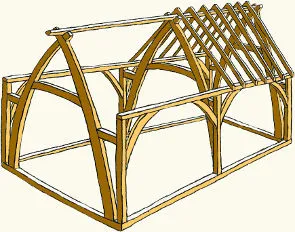
Green oak frames span a wide spectrum of types. With its remarkable adaptability, this material offers a realm of design possibilities, catering to individual aesthetic and structural requirements.
This is a brief overview of some of the carpentry tools and
equipment used by Sessile Oak, rather than a guide to their use.
These tools have the potential to cause serious injury and should not be
used without proper training and experience or professional guidance.


