

Home  Design  Carpentry  Construction  Gallery  Contact 

 Green Oak Framing - Construction Process

Unloading the shaped timbers

Site Preparation and Arrival

Having inspected the site on at least one occasion during the design and fabrication stages of the project, points of access for timbers and equipment will already have been established. Depending on the nature of the project, the masonry or foundations will have been marked for levels, setting out points and tying in points.
The timbers are unloaded and stacked ready for use as close as practicable to the build area and a clear marshalling area set aside for organising and assembling the frame. Where timbers are to be manoeuvred by crane, space must be allowed for the crane to gain access and operate within reach of both the marshalling and build areas.

Setting Out and Fitting the First Layer

The first parts of the frame to be fitted are usually the sole plates (where the timbers sit on foundations) or wall plates (where a roof frame sits on pre-existing walls). They are set out in predetermined positions relative to the established setting out points over a damp-proof course to prevent any transfer of moisture from the masonry.

Timbers laid out and ready for assembly
Fitting posts and braces

Building Upwards from the Sole Plates

When the sole plates are level and square, the posts can be put into position along with their braces in readiness for the next layer of timbers. In this respect, there is always a strict sequence of fitting which must be followed.
As the build progresses, the frame rapidly takes shape. In a relatively short period of time the series of timbers placed along the top of the masonry give rise to a fully formed structure.

Craning a sling brace truss into position
Installing floor beams around a braced stair well

Although the vast majority of the carpentry work is performed in the workshop, there are always a few minor tasks to be carried out on site throughout the build. They vary according to the nature of the project, though invariably include the drilling of fixing points between frame and masonry. With this in mind, it is important to have access to a nearby electricity supply to provide power to essential site tools.

Braced stair well and floor frame
Driving the pegs home

Pegging

At Sessile Oak, we use only high quality oak pegs made from straight-grained timbers of a low moisture content. Not only does this make them stronger when driven home, it also means that they are less prone to shrinkage as the frame matures - ensuring a tight fit as the years pass.
Innitially, joints are often held in place by podgers in place of the pegs to allow for the maneuvering of timbers. Even without any of the pegs in place, the frame can be completely rigid and self-supporting.

Pegged brace joint
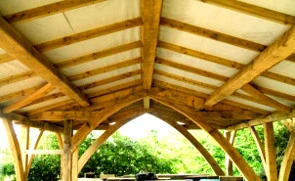
Fitting a shallow pitched king post truss

Fitting the Roof

With the lower part of the frame erected, or masonry walls prepared and the wall plates in position, the roof timbers can be put into place.
Where the roof timbers form part of the lower structure too (as with cruck or sling braced frames), these different stages are usually merged into one.

Trimming the pegs
Complete frame

The Completed Frame

Before too long, the frame is up, pegged and ready for the next stage of the project.
In the meantime, the frame should be made secure against the elements without delay to prevent unnecessary water-marking.

Finished frame wrapped in plastic for shelter
Fixing common rafters Finished frame with stud-work and membrane

Subsequent Works

It is recommended that arrangements be made for the relevant trades to move onto the site at the earliest opportunity to install such items as roofing, cladding, glazing, fittings, plastering and so forth.

Oak stairs
  Green oak frame workshop processes   Green oak frame carpentry tools
Oak Frame
Workshop
Process
Oak Frame
Carpentry
Tools

Plant & Equipment

Scaffolding and Staging Boards

Where a frame is to be installed upon an existing structure (eg. on masonry walls) or constructed to a height which cannot be reached safely from ground level, scaffolding is erected to provide a secure working platform. Where work is to be carried out at lower heights or between trusses, staging boards are used. They can be placed on trestles or tie beams in order to straddle bays to allow the fitting of roof timbers.

Ladders

Ladders are essential on any construction site. It is important to secure them at the top to prevent movement. They should also be removed at the end of every working day for safety and security.

Timber Trolley

Timbers are commonly marshalled with a small trolley. Whilst very maneuverable, they can become unstable on uneven ground or when encountering an obstruction, so it is best to maintain a clear and tidy site.

Crane

On larger projects, or even where a single large timber is to be lifted, it is often necessary to hire a crane and operator. The size varies according to the weight and distance to be lifted. Provision is made for access and a "banksman" is designated to direct the operator via either hand signals or radio.

Health & Safety

Personal Kit

Building sites are amongst the most hazardous of working environments. It is vital that everybody on site is properly equipped to work safely and efficiently. As an absolute minimum, personal kit must always include: helmet; safety boots; ballistic goggles; ear protectors; safety harness, and; hi-viz clothing. Where masonry is to be cut, an "air-fed" respirator is recommended.

Clearly Defined Responsibilities

Everyone on site must have a clear understanding of their role and responsibilities. Any ambiguity has the potential to cause oversight and mishap.

First Aid

All site personnel must know the location of all first aid equipment, the nearest telephone and the site address. Qualified "First Aiders" are identified so that necessary treatment may be administered immediately.

COSHH

Generally, green oak construction will not involve the use of harmful substances. If adhesives are required, they are applied carefully and any residue cleaned and removed from site.

---------------------------------------

This is a brief overview of construction processes used by Sessile Oak, rather than a guide to the construction of timber framed buildings. Structural timber framing should not be practised without proper training and experience or professional guidance.

Copyright © 2008-2010 Sessile Oak. All rights reserved worldwide.   RSS 2.0   Website design by Oh-Gosh! Graphics.